AI Slop vs Human Content: Can You Actually Tell the Difference in 2026?
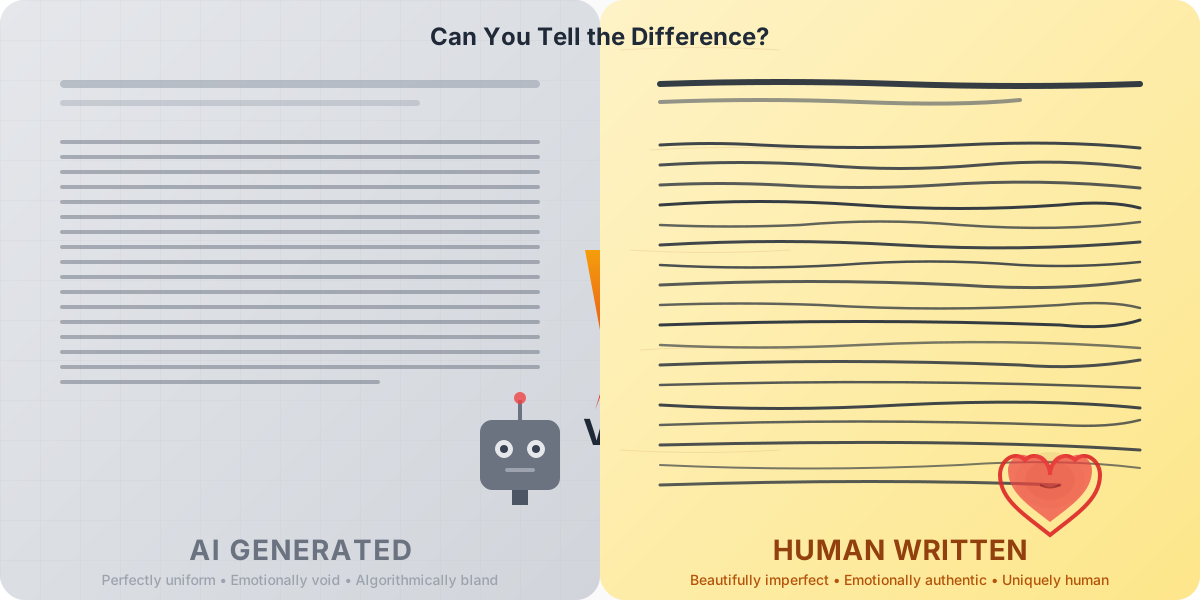
There’s a game on this site that captures the confusion of 2026. In Human Verification, you compare human and AI responses and make a judgment without treating the result as proof of authorship.
Here’s the humbling part: it’s harder than you’d think.
The gap between AI and human content is closing. What used to be obvious tells are getting harder to spot. And that raises an uncomfortable question: does it even matter if we can tell the difference anymore?
The Growing Difficulty
A year ago, spotting AI was easy. The writing was stilted. The examples were generic. It had all the personality of a corporate handbook written by committee.
But AI has gotten better. Much better. The latest models can mimic conversational tone. They can include specific details. They can even seem to have a point of view, though it’s often a composite of every point of view ever written.
This is both impressive and troubling. We used to say “you can tell because it’s too perfect.” Now that’s not true. We used to say “you can tell because it’s too generic.” The models have learned to seem more specific.
So what’s left?
What Makes Human Content Different
Here’s what I think is still the fundamental difference: humans have actually lived.
A human writing about their worst day at work has had a worst day at work. They’ve felt the specific dread of a Monday morning when everything went wrong. They can describe the taste of bad coffee in a fluorescent-lit break room in a way that makes you wince with recognition.
AI has never had a bad day. It’s never felt dread. It can describe these things in theory, but there’s something missing — the lived texture of actual experience.
Human content also has what I’d call “the right to be wrong.” Humans have opinions that are sometimes incorrect. They make jokes that don’t land. They go on tangents that don’t make sense. This messiness is actually a feature, not a bug. It’s proof that a real brain was involved.
AI tends to be too careful. It hedges. It qualifies. It presents balanced views on things that don’t need balancing. Real humans are willing to be confidently wrong about things. That’s human.
What Gives AI Slop Away
Even as AI improves, there are still tells. They’re just more subtle now.
The over-explaining. AI tends to define things that don’t need defining. “As you know, Bob” types of setups. Explanations of concepts that any human reader would already understand.
The tone consistency. AI tends to maintain a very even emotional register. Humans have ups and downs in their writing. We get excited about something, then trail off. We start strong, then lose energy. This inconsistency is human.
The lack of specific contradiction. When a human writes about a topic they’ve thought about for years, they often contradict themselves. They’ve changed their mind. They’ve refined their thinking. AI tends to present a single coherent view because it’s drawing from many sources.
The absence of the weird. Humans include things that don’t quite fit. Tangents. Inside jokes. References that are too specific to matter. AI tends to stay on topic in a way that feels almost robotic.
What About AI Detection Tools?
There are dozens of tools now that claim to detect AI content. Some are built into platforms. Some are standalone services. Some are browser extensions.
Do they work?
The honest answer is: sometimes, but not reliably. These tools look for patterns — the patterns we just discussed. But as AI gets better at mimicking human patterns, these tools become less accurate. They’ve also been known to flag human content as AI, especially if the human writes in a particular style.
The better approach is what Human Verification does: practice making a cautious judgment while remembering that style is not proof. The more examples you examine, the better you get at noticing things that don’t quite sit right and checking them against provenance.
Why It Matters
Some people argue: who cares if something is AI-generated, as long as it’s good?
That’s a fair question. But here’s the thing: most AI slop isn’t good. It’s mediocre. And the problem isn’t just the content itself — it’s what happens when humans stop creating.
If everything can be generated by AI, what’s the incentive for humans to make things? If you can just churn out SEO-optimized articles, why would anyone spend months researching and writing something original? The economics get destroyed. The motivation gets destroyed. The diversity of perspectives gets destroyed.
There’s also a trust issue. When you know something might be AI-generated, you approach it with more skepticism. But constant skepticism is exhausting. And it makes it harder to find the human content that actually deserves your attention.
A Human Alternative
This is why Your AI Slop Bores Me matters as a different kind of experiment. People submit text or drawing prompts in Human mode, and other people answer in LARP as AI mode. No actual AI writes the replies.
Every exchange makes the human labor visible. Someone has to decide what to ask, another person has to make the response, and the credit loop connects receiving with contributing.
And maybe that’s the best we can hope for in 2026. Not perfect detection, but a trained instinct. A sense for when something feels off. A habit of questioning what you’re reading.
Because the internet isn’t going to get less AI-heavy. The question is whether we can stay sharp enough to find the human stuff that actually matters.
The Future
The gap will keep closing. AI will keep improving. At some point, it might be genuinely impossible to tell the difference.
But I don’t think that means human content becomes worthless. I think it means human content becomes more valuable precisely because it’s rare. When everything could be made by machines, the things that are unmistakably human — our specific experiences, our actual opinions, our unpolished perspectives — become the differentiating factor.
That’s the game we need to play: not just detecting AI slop, but creating more human content. Being weirder. Being more specific. Being willing to be wrong in interesting ways.
The machines can have the middle. We’ll take the edges.
Ready to test your detection skills? Try Human Verification. If you would rather make something for another person, visit the original prompt exchange at youraislopbores.me.