AI Detector False Positives in 2026: Why Scores Aren't Proof
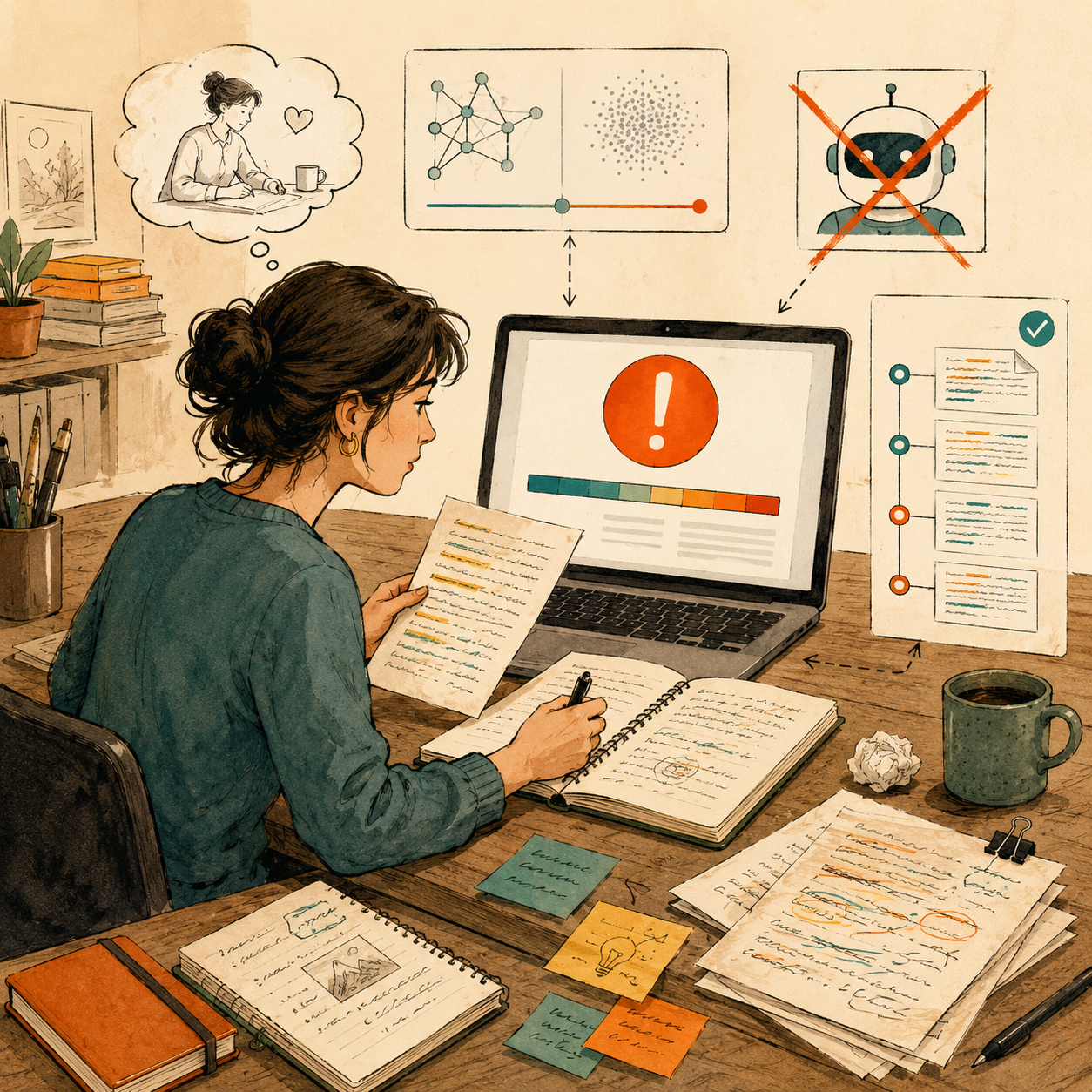
If you have ever been told a piece of writing “scored 87% AI” and watched a teacher, editor, or client treat that number like a fingerprint, you have met the AI detector false positives problem. In 2026, the tools are prettier, the dashboards are slicker, and the underlying statistics are still not evidence of authorship. That gap — between a confident-looking score and what it can actually prove — is where careers, grades, and reputations are getting bruised.
This guide is for writers, students, editors, teachers, and readers who want to judge detector claims like adults instead of jurors. We will walk through why false positives happen, what to do before accusing someone, how to preserve drafts so you can defend yourself, and how to use Human Verification as training for your own eye — not as proof against anyone else.
What “AI Detector False Positives” Actually Means
A false positive is when a detector labels human writing as AI-generated. It does not mean the tool is broken in a dramatic way; it means the tool is doing what all classifiers do — guessing, with confidence intervals it rarely shows you. Detectors typically look at statistical fingerprints: perplexity (how “surprising” the next word is), burstiness (variation in sentence length and complexity), and token-level patterns that tend to be smoother in machine-generated text.
The problem is that plenty of humans write smooth, low-perplexity prose on purpose. Polished essayists, technical writers, corporate communicators, and non-native English speakers who learned from structured materials all tend to produce text that resembles the very patterns detectors flag. A student who edits carefully can look “more AI” than a sloppy first draft written by a chatbot.
Why 2026 Is Not the Year Detectors “Got Solved”
Every year, vendors claim their newest model has cracked the problem. Every year, independent testers find the same failure modes: false positives on non-native speakers, false positives on heavily edited human work, and false negatives on lightly paraphrased AI output. The arms race between generators and detectors has structural asymmetry — generators only need to fool the detector once, and detectors need to be right every time on text they have never seen.
If you want the longer version of the “how to actually tell” question, our companion piece How to Spot AI-Generated Content covers the human-eye signals that hold up better than any dashboard number.
Why Detector Scores Are Weak Evidence
Treat a detector output the way you would treat a single lab result with no reference range: interesting, not conclusive. Here is why the score alone is thin:
- No chain of custody. The tool cannot show you which sentences it “learned” from or why it weighted them. You get a percentage, not a proof.
- Base-rate blindness. If most of the writing you evaluate is human, even a small false-positive rate produces a lot of wrongly flagged humans.
- Training drift. Detectors are trained on yesterday’s models. Today’s writers — human and machine — have already moved.
- Prompt sensitivity. Paste the same paragraph twice with a line break difference and the score can move several points.
- No motive or context. The detector doesn’t know the writer’s first language, editing habits, deadline pressure, or whether they used spellcheck.
None of this means detectors are useless. It means they are a smoke alarm, not a courtroom. A high score is a reason to ask more questions, not a reason to deliver a verdict.
What Institutions Actually Did in the 2026 Commonwealth Case
The 2026 Commonwealth Short Story Prize controversy is worth studying because the institution did the thing detectors cannot do: it reviewed drafts, notes, and process rather than relying on a single score. When authorship was questioned, the response was to ask for evidence of the work — versions, revisions, the paper trail — instead of pointing at a dashboard and calling it a day.
That is the template. Serious institutions in 2026 are increasingly treating detector output as one input among many, and asking writers to demonstrate process. That protects honest writers and makes it harder for genuinely dishonest ones to hide behind a clean score.
Practical Checklist: Before You Accuse Someone
If you are a teacher, editor, manager, or client staring at a suspicious score, run this checklist before you say the word “AI” out loud.
1. Ask for process, not confessions
Request drafts, outlines, notes, browser history for research, or a short conversation about the piece. Someone who wrote it can usually talk about the choices they made. Someone who did not, usually cannot.
2. Run the same text through more than one detector
Different detectors disagree constantly. If three tools give you three different percentages, you have learned something about the tools, not about the writer.
3. Consider the writer’s baseline
Compare the flagged piece to previous work you know is theirs. Consistent voice, quirks, and mistakes across time are much stronger signals than a single score.
4. Account for non-native English
Detectors have a documented tendency to over-flag non-native English writers whose grammar is careful and vocabulary is measured. If your flag rate correlates with language background, your tool is the problem.
5. Separate “AI-assisted” from “AI-generated”
A writer who used a spellchecker, a grammar tool, or a translation assist has not “written with AI” in any meaningful cheating sense. Decide what your actual rule is before you enforce it.
Practical Checklist: Preserve Drafts and Version History
If you are the writer, defend yourself before you need to.
- Write in tools that keep version history — Google Docs, Notion, Word with track changes, or any editor with autosave snapshots.
- Keep your notes. Outlines, scribbled margins, voice memos, and research tabs are all evidence of process.
- Commit early and often if you write in Markdown and use git. A commit log is a timeline no detector can invent.
- Save your prompts if you did use AI. Being honest about assistance is safer than being caught minimizing it.
- Export a “process packet” when you submit important work: draft one, draft two, final, plus notes. If anyone questions authorship, you hand them the packet instead of arguing about a percentage.
Use the Game as Training, Not Proof
Human Verification is built to exercise your judgment around low-effort AI writing: hollow transitions, weightless hedging, sentences that sound confident about nothing. Play it, notice patterns, then check provenance.
But do not use your score in a browser game as evidence against a real human being. The game trains intuition; it does not certify authorship. That distinction matters, because the whole point of this article is that no single number — not a game score, not a detector percentage — should decide whether you trust a piece of writing.
If you want to go deeper on the difference between machine sludge and real human work, our breakdown of AI slop vs. human content is the companion read.
What About SEO and “Google Will Punish AI Content”?
A related myth deserves a quick knock-down, because it fuels a lot of the detector panic. Google’s public guidance in 2026 continues to reward helpful, people-first content regardless of how it was produced, and its enforcement is aimed at scaled content abuse — mass-produced pages designed to game search — not at individual writers who used a tool to help with a draft. We wrote the longer version of this in Does AI Content Hurt SEO?, and it is worth reading before you let a detector score decide your publishing strategy.
The through-line: quality and usefulness are the standard. “Was a machine involved” is not.
A Saner Policy in One Paragraph
Treat detector scores as prompts to investigate, never as verdicts. Ask for process. Compare against baselines. Account for language background and editing style. Preserve your own drafts so you can defend your work. Train your eye with games and reading, not with dashboards. And if you want the full field guide to the broader ecosystem — what slop is, how it spreads, and what to do about it — start with our complete guide to AI slop.
The tools are not going to get honest on their own. Your judgment has to.