YouTube Music Has AI Labels. Now Give Listeners a Choice.
YouTube Music has started labeling music created primarily with generative AI. Good. A label is better than making every listener play forensic detective while the chorus melts into its fourth key change.
But disclosure answers only one question: how was this made? It does not answer whether the track is good, whether the uploader is honest, or whether you want the recommendation system to serve you another fifty of them.
Hero image disclosure: AI-assisted editorial illustration; not a product screenshot.
What YouTube actually announced
On October 14, 2026, YouTube announced that YouTube Music was rolling out labels for songs made primarily with generative AI, including tracks where a model generated the composition and vocals. The label appears on the player page, and tapping it reveals more information. YouTube says it is working with music partners and using its own detection tools to identify qualifying tracks. It also plans to bring the labels to the main YouTube app.
That is a rollout, not a declaration that every synthetic track is now perfectly identified everywhere. Detection systems miss things. Metadata can be incomplete. Uploaders can be evasive. The label is useful context, not a magic truth sticker.
YouTube made another useful distinction in its May 27 update on AI labels: a disclosure by itself does not change recommendation treatment or monetization eligibility. That matters. Labeling explains provenance; moderation and ranking are separate decisions.
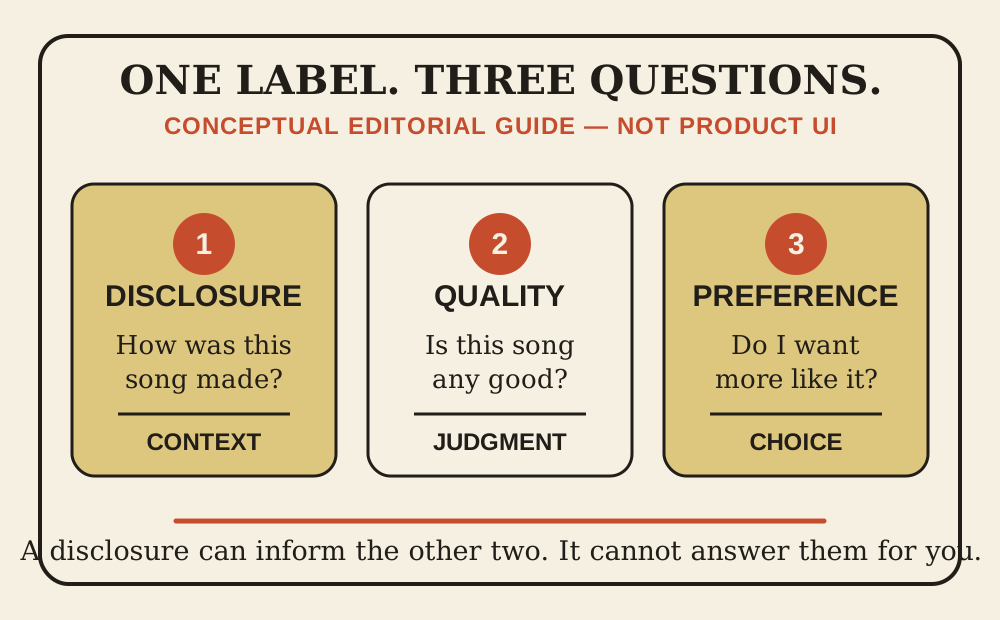
A label is information. A preference is power.
Imagine a nutrition label that tells you exactly what is in the cereal, then locks the supermarket trolley and fills it with twelve more boxes anyway. Transparent? Technically. Respectful of your choice? Not especially.
YouTube Music has done the first half of the job. Now it should add listener controls that match the disclosure:
- Show me less primarily AI-generated music. A preference signal, not a moral tribunal.
- Exclude it from autoplay and radio. Let deliberate searches remain available while passive listening stays chosen.
- Filter a playlist or search result. Useful for people browsing by production method, either for or against it.
- Explain why a labeled track appeared. “Because you played this artist” is more informative than algorithmic incense.
These are product recommendations, not features YouTube has announced. There is currently no documented listener switch in these announcements that excludes AI-labeled music from recommendations.
The point is not that generated music is automatically bad. Human musicians have produced oceans of forgettable sludge without silicon assistance. The point is that production method can matter to a listener, just as live versus studio, explicit versus clean, or original versus tribute can matter. Once the platform has decided the distinction is meaningful enough to display, it should be meaningful enough to use.
How to use the label without becoming unbearable
Until better controls exist, use a three-step listening rule.
First, read the disclosure as provenance, not a verdict. A label says something about process. It does not prove plagiarism, deception, low effort, or low quality.
Second, judge the track itself. Does it make a specific choice? Does it reward another listen? Does somebody appear responsible for the result? Our guide to why AI slop feels so obvious explains why intention and specificity matter more than polished surfaces.
Third, manage the stream around it. Skip, dislike, remove, or stop using autoplay when the feed becomes a conveyor belt of interchangeable songs. If constant provenance-checking is exhausting, the deliberate listening habits in AI Content Fatigue are more useful than trying to identify every synthetic hi-hat by ear.
The next label should be a choice
YouTube deserves credit for putting the information on the player instead of burying it in a help page. The company should now connect that information to listener agency.
Tell us what the track is. Then let us decide whether the machine should keep playing more of it.