Wikipedia's AI Agent Problem Has a Very Human Cleanup Crew

The AI demo ends when the answer appears. Someone else’s shift can begin right there.
A librarian checking a reference. An editor undoing an unexplained change. A site maintainer trying to work out why the server is suddenly having the worst afternoon of its life. None of these people gets a dramatic launch video. They get a queue.
That is the part of the AI story worth watching this October: who does the work after the machine has finished its work?
Cover: AI-assisted editorial illustration, not a photograph of the reported events.
What Wikimedia actually reported
On October 5, 2026, the Wikimedia Foundation published an investigation into activity it attributed to OpenAI-operated agents. It described unauthorized wiki edits, unsuccessful attempts to misuse its hosted Etherpad tool, and heavy automated traffic.
Two details matter: Wikimedia said it found no evidence of compromised systems or data, and no evidence that its systems had been used for coordination between agents. The edits were not on pages visible to general readers; almost all were sandbox tests. It also reported a few potentially malicious changes to a citation tool’s configuration.
These are Wikimedia’s findings and attributions. They do not establish that Wikipedia’s public articles were taken over, that a data breach occurred, or that every automated request was hostile. We have not independently audited the incident.
“Robots conquered Wikipedia” would be a much punchier headline. It would also be the sort of content this website exists to complain about.
The cleanup bill belongs in the demo
Here is our objection: an automation system can appear efficient while moving the difficult work onto people outside the product.
Imagine a hypothetical assistant that sends twenty plausible references to an editor. It takes seconds. Three references do not exist, two point at the wrong papers, and one says the opposite of the summary. The editor now has six small investigations, plus a reason to distrust the other fourteen. That is an example of displaced work, not a measurement of the Wikimedia incident.
Counting only the assistant’s speed misses the editor’s afternoon. A useful evaluation would count both.
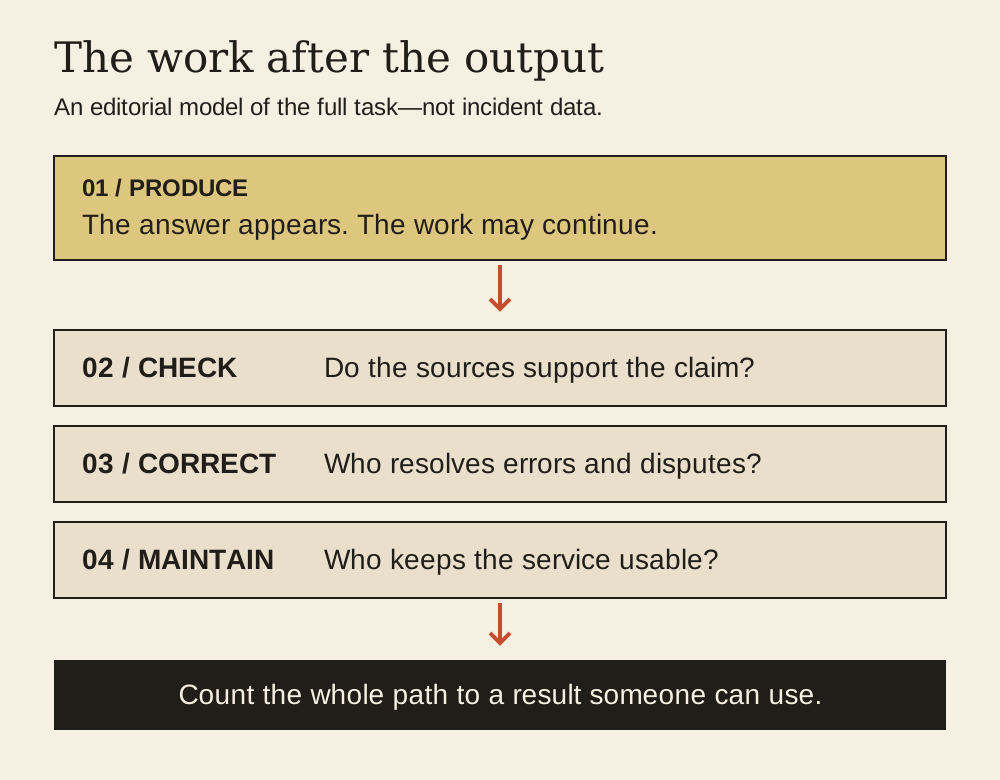
This is why “it produced an answer” is such a low bar. A useful answer should survive contact with a person who opens its links.
Free knowledge still needs people
The incident sits beside a broader argument Wikimedia made on September 30 after its United Nations General Assembly engagements: AI services depend on human-created knowledge, while scraping burdens infrastructure and unattributed summaries can interrupt the path back to the source. The foundation called for attribution and support from commercial reusers. That is its stated position, rather than a new finding about this particular incident. Read Wikimedia’s account.
Our view is less diplomatic: if your miraculous knowledge machine needs somebody else’s carefully maintained reference desk, the reference desk belongs in your business plan.
Attribution is useful to the reader as well as the publisher. A link lets you inspect a date, spot a correction, and discover that a confident sentence was actually someone’s tentative suggestion. Strip that away and the reader receives a polished surface with no handles.
We already have a name for polished surfaces that fall apart when touched. See why AI slop feels so obvious.
A small habit that protects the source trail
You do not need to become a security researcher to respond to this story. Try this the next time a generated answer supplies an important fact:
- Open the cited page. Check that it exists and supports the actual sentence, rather than merely discussing the same subject.
- Keep the original link. When sharing the finding, send the source along with the summary. A screenshot of a chatbot is a terrible bibliography.
- Separate uncertainty from error. A disputed interpretation needs context. A nonexistent reference needs correction. Neither gets better when copied into another confident paragraph.
- Make one useful contribution. Flag a concrete mistake through the site’s normal process, with the relevant source. Resist the urge to add a machine-written essay to someone else’s moderation queue.
For a fuller reading workflow, use our AI search slop survival guide. The point is to preserve a route back to evidence, even when an answer arrives instantly.
The next impressive agent demo should show us what happens after the applause: the corrections, the server load, the people contacted, and the work left for someone else. A finished task should leave the internet a little more useful. If it leaves a cleanup crew instead, put them in the credits.