Spotify Cut 50 Million Slop and Spam Tracks From Recommendations.

AI-assisted editorial illustration; not a product screenshot.
Spotify has found a glamorous new use for the skip button: evidence.
The company’s latest “human artistry” announcement arrives with a huge number and a clean moral: the feed is being rescued. The number is a self-reported metric. The moral needs reading glasses.
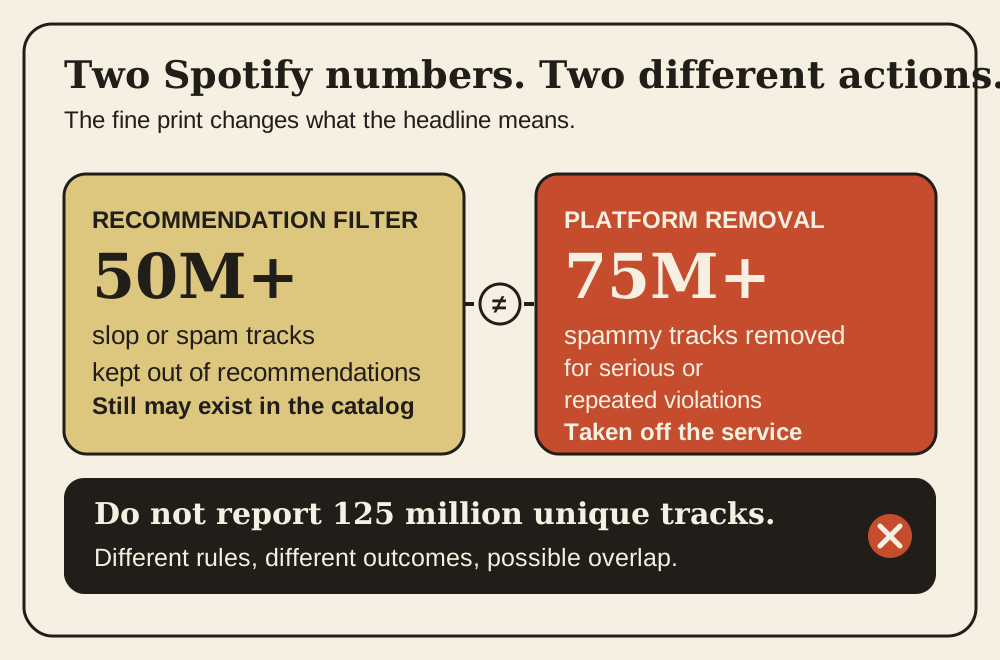
The distinction matters. A song can remain available while the algorithm stops volunteering it. If you want to understand whether Spotify cleaned the catalog, cleaned the feed, or simply moved the mess behind a search box, you have to read past the triumphant number.
What Spotify actually reported
Spotify’s October 20 announcement reports over 50 million slop or spam tracks excluded from recommendations this year, plus over 75 million spammy tracks removed for serious or repeated violations. These are distinct actions; the announcement does not establish non-overlapping totals. Spam is not necessarily AI-generated.
Spotify describes combining feedback, upload behavior, metadata, and imperfect AI detectors. These are self-reported results, not independently audited here; the announcement supplies no false-positive rate or numerical decrease in listener concerns.
Our analysis: the feed is the real battleground
Removing bad uploads is useful. Controlling recommendations may be more important.
A catalog can contain an ocean of junk without ruining your evening if the system never pushes it into Release Radar, autoplay, radio, or a mood playlist. Recommendation slots are scarce. Every anonymous, mass-uploaded near-duplicate that occupies one is a track from a musician, scene, or label you did not encounter.
That is why the 50 million figure matters even though those tracks may still exist. Spotify is acknowledging that availability and amplification are different decisions. The platform does not merely host music; it decides which music gets a chance to become familiar.
The uncomfortable part is that the classification remains probabilistic. High-volume upload patterns and suspicious metadata can expose industrial spam. Listener skips can reveal boredom. Neither tells you, by itself, whether a track used AI responsibly, whether a human made something dull, or whether an experimental release simply found the wrong audience. Detection tools add another uncertain vote, not a magic slop meter.
This is the same problem behind AI detector false positives: a useful signal becomes dangerous when somebody mistakes it for a verdict.
A practical test for listeners
Do not wait for a platform-wide victory banner. Treat recommendations as a garden with a slightly overconfident robot holding the hose.
First, give explicit feedback. Hide tracks you do not want, save the ones you do, and follow artists you would deliberately return to. Passive skipping is still information, but an unambiguous choice is cleaner.
Second, inspect provenance when a track feels oddly interchangeable. Look for a coherent artist page, credits, release history, label information, and evidence that the act exists beyond one frictionless upload. None of these proves humanity. Together they give you more to judge than a glossy cover and a keyword-stuffed title. Our guide to spotting AI-generated content offers a broader evidence-first checklist.
Third, escape the recommendation loop. Follow a human DJ, a small label, a local venue, a critic, or a friend whose taste has consequences. The best discovery system is often a person willing to be wrong in public.
What artists and curators should watch
For artists, the immediate question is not only “Will my track stay online?” It is “Will the system quietly stop showing it?” Those outcomes demand different appeals and different evidence. Keep accurate credits, consistent metadata, and clean release records. If reach drops, separate catalog availability from playlist eligibility before diagnosing the cause.
For curators, Spotify’s announcement is a reminder to document why a track belongs. Editorial judgment should leave a trail richer than “the model liked it.” That principle also applies to the platform-labeling debate covered in our YouTube Music analysis: disclosure helps, but labels cannot replace judgment about quality, deception, or authorship.
Spotify deserves credit for naming the recommendation layer and admitting detection limits. It has not earned a victory lap from self-reported totals alone. The fine print describes a partial cleanup that readers cannot independently audit from this announcement—which is less cinematic than deleting 125 million robot songs, but considerably more useful.