How to Spot AI-Generated Content: 15 Tells (2026 Field Guide)

You can feel it before you can name it. A paragraph that’s grammatically perfect and somehow says nothing. A photo where the smile is right but the hands are wrong. A “thought leadership” post that reads like it was assembled from other thought leadership posts.
That feeling is your pattern-recognition firing. This guide turns that gut reaction into something you can explain — and check — in about 30 seconds.
No detector app required. Honestly, those barely work (more on that below). What works is knowing where machines cut corners, and stacking a few tells before you make a call.
Why bother learning this?
Because the cost of being fooled went up. AI-generated content now shows up in product reviews you’re about to trust with your money, news you’re about to share, dating profiles you’re about to message, and the search results you used to rely on. Being able to tell “made by a person who actually knows this” from “generated to fill a slot” is fast becoming a basic literacy skill — like spotting an ad or a scam.
The good news: machines are predictable. They fail in the same places over and over.
The text tells
Large language models optimize for the most likely next word. That single fact explains almost every tell below — they drift toward the average, the safe, the expected.
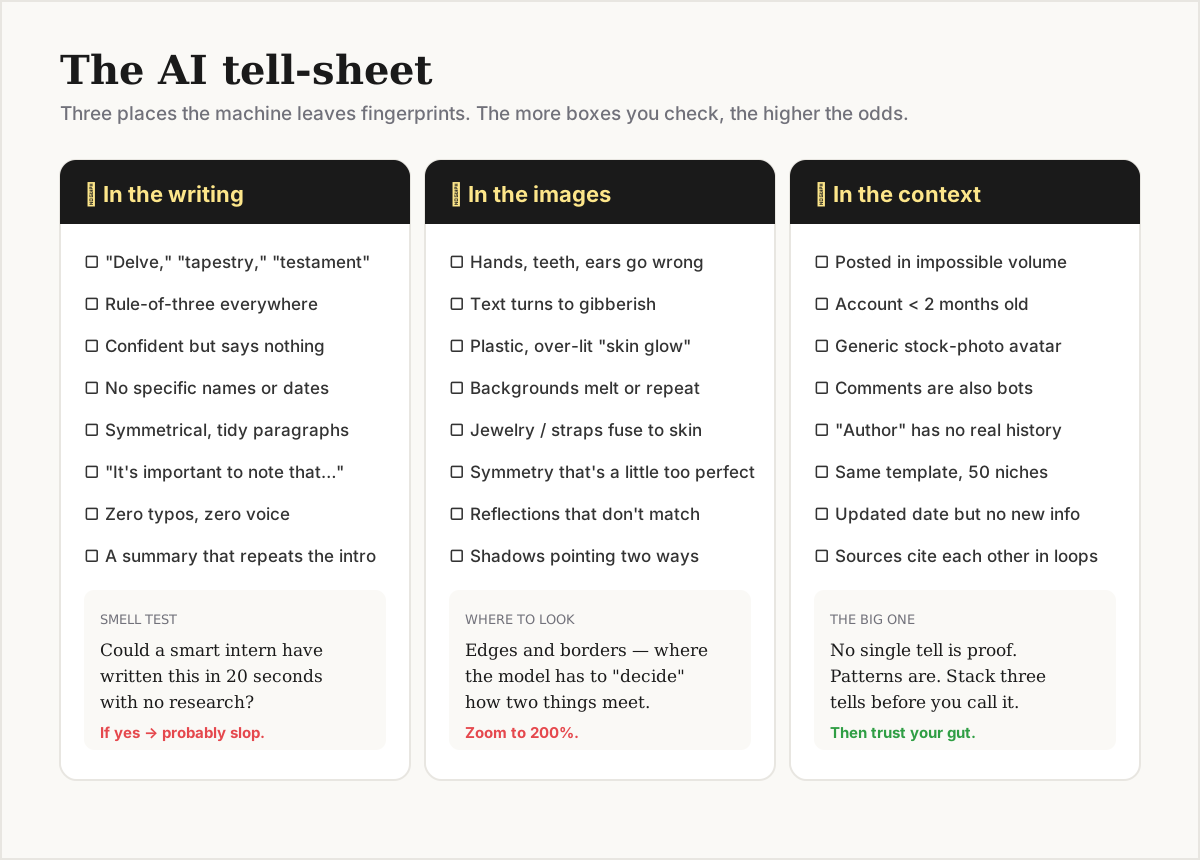
1. The vocabulary fingerprints. Certain words are wildly over-represented in AI text: delve, tapestry, testament, realm, navigate, landscape, underscore, multifaceted, crucial. One or two means nothing. A cluster in 200 words is a flashing light.
2. “It’s important to note that…” AI loves hedging connectors and throat-clearing: it’s worth noting, in conclusion, when it comes to, in today’s fast-paced world. They’re filler that sounds like structure.
3. The rule of three, on repeat. “Efficient, scalable, and reliable.” “Engage, inspire, and convert.” Humans use triads occasionally. AI reaches for them in nearly every sentence because balanced lists are statistically smooth.
4. Confident, and empty. Read a paragraph, then ask: what did it actually claim? Slop is fluent at the sentence level and hollow at the idea level. It describes the shape of an insight without having one.
5. No specifics that cost something. Real expertise leaks detail — a date, a price, a name, a number that someone had to look up or live through. AI defaults to “many experts,” “studies show,” “in recent years.” Vague by design.
6. Suspiciously tidy structure. Every paragraph the same length. Every section a neat intro-body-summary. A conclusion that just restates the introduction in new words. Human writing is lumpier because human attention is lumpier.
7. No voice, no risk. No jokes that could fall flat, no strong opinion, no weird tangent, no “okay this part is boring but bear with me.” AI is allergic to risk, and voice is risk.
For a deeper look at why this happens, we wrote a whole piece on it: why AI slop feels so obvious.
The image tells
Image models fail at the boundaries — anywhere they have to “decide” how two things meet.
8. Hands, teeth, ears. Still the classics. Count fingers. Check whether teeth are a uniform wall. Look at where glasses meet the temple.
9. Text turns to soup. Signs, labels, book spines, logos in the background melt into pseudo-letters. Models render the texture of text without the meaning.
10. The plastic glow. Skin that’s too even, lighting that’s too flattering, that faint “rendered” sheen. Portraits look like they were dipped in wax.
11. Physics that doesn’t add up. Shadows pointing two directions. A reflection that doesn’t match what’s in front of the mirror. Jewelry, straps, or hair that fuses into skin.
12. Background repetition. Crowds where three people share a face. Tiles, bricks, or foliage that tile a little too perfectly. Zoom to 200% and scan the edges — that’s where it breaks.
The context tells (the underrated ones)
The strongest signals often aren’t in the content at all. They’re around it.
13. Impossible volume. An “author” publishing 14 in-depth articles a day across unrelated niches. A profile posting more than any human could write. Volume is the cheapest thing AI buys.
14. Hollow provenance. Brand-new account, stock-photo avatar, no posting history, no real-world footprint. The comments are bots replying to bots. There’s no person you can trace back to.
15. Circular sourcing. The article cites a “study” that links to another AI article that links back. Real reporting eventually touches something concrete — a named researcher, a primary document, a court filing. Slop cites a hall of mirrors.
The 30-second method
You don’t need to run all 15 every time. Do this instead:
- Read one full paragraph and ask: did it claim anything I couldn’t have guessed? No → suspicious.
- Scan for two or three vocabulary fingerprints. Found a cluster → more suspicious.
- Check the source, not just the text. Who posted it? Do they have a real history? No → call it.
The principle that matters most: no single tell is proof. A human can write “delve.” A great photographer can produce a too-perfect portrait. You’re looking for patterns — three tells stacked, not one. Stack three, and your gut is almost always right.
Why AI detectors don’t save you
You’ll be tempted to outsource this to a “98% accurate AI detector.” Don’t trust the number. These tools work by measuring how predictable text is (perplexity and burstiness), which causes two expensive failures:
- False positives on real people. Plain, competent, well-edited human writing scores as “AI” constantly. Non-native English speakers get flagged the hardest — a documented bias that has wrongly accused students of cheating.
- Trivial to beat. One pass of “rewrite this to sound more human,” or a few manual edits, and detectors fold.
Use them as one weak signal among many, never as a verdict. Your eyes and the context tells are more reliable than the score.
Want to train your eye for free?
The fastest way to practice is reps, paired with humility about what style can prove. Human Verification lets you compare human and AI responses, make a call, and then inspect why you made it.
If you’d rather make it a live, head-to-head match, try ArenAI — pick a side, human or AI, and let the audience judge. Or start with the complete guide to AI slop for the bigger picture.
And once you can spot it reliably, the natural next question is how to fix it. That’s the sibling piece: how to humanize AI writing.
Frequently asked questions
What is the easiest way to spot AI-generated text? Read one paragraph and ask if it claimed anything specific. Slop sounds fluent but says nothing — no names, dates, or numbers a person would have to know.
Are AI content detectors accurate? Not reliably. They false-flag real human writing (especially from non-native speakers) and are beaten by a single rewrite. Use them as a weak hint, not a verdict.
How do I tell if an image is AI? Inspect the edges: hands, teeth, ears, melted background text, mismatched shadows and reflections, and a too-perfect plastic glow.
Can you ever be 100% sure? No. Stack three or more tells across the writing, the images, and the context — that’s as close to certain as it gets.
The internet doesn’t have to be a wasteland of generated filler. Learning to inspect it is step one. Practice with Human Verification, check the evidence behind your gut reaction, and refuse to let AI slop bore you.