How to Humanize AI Writing: 9 Edits That Kill the Slop

Using AI to draft is fine. Shipping its first draft is the problem.
Raw model output has a texture — smooth, balanced, agreeable, and completely forgettable. Readers feel it even when they can’t name it, and search engines increasingly reward content that shows real experience over content that just fills the page. “Humanizing” isn’t about tricking a detector. It’s about putting a pulse back in writing that a machine flatlined.
Here are the nine edits that do the most work, with before-and-afters you can copy.
First, why AI sounds robotic
A language model predicts the most probable next word. Average in, average out. It has no memory of a specific Tuesday, no opinion it’s nervous about, no reason to take a swing. So it produces prose that is grammatically immaculate and emotionally weightless — the literary equivalent of elevator music.
Every fix below is really the same move: add back the specific, the opinionated, and the uneven — the three things probability smooths away.
The 9 edits
1. Replace the abstraction with one concrete detail
This is 80% of humanizing. Vague nouns are where slop hides.
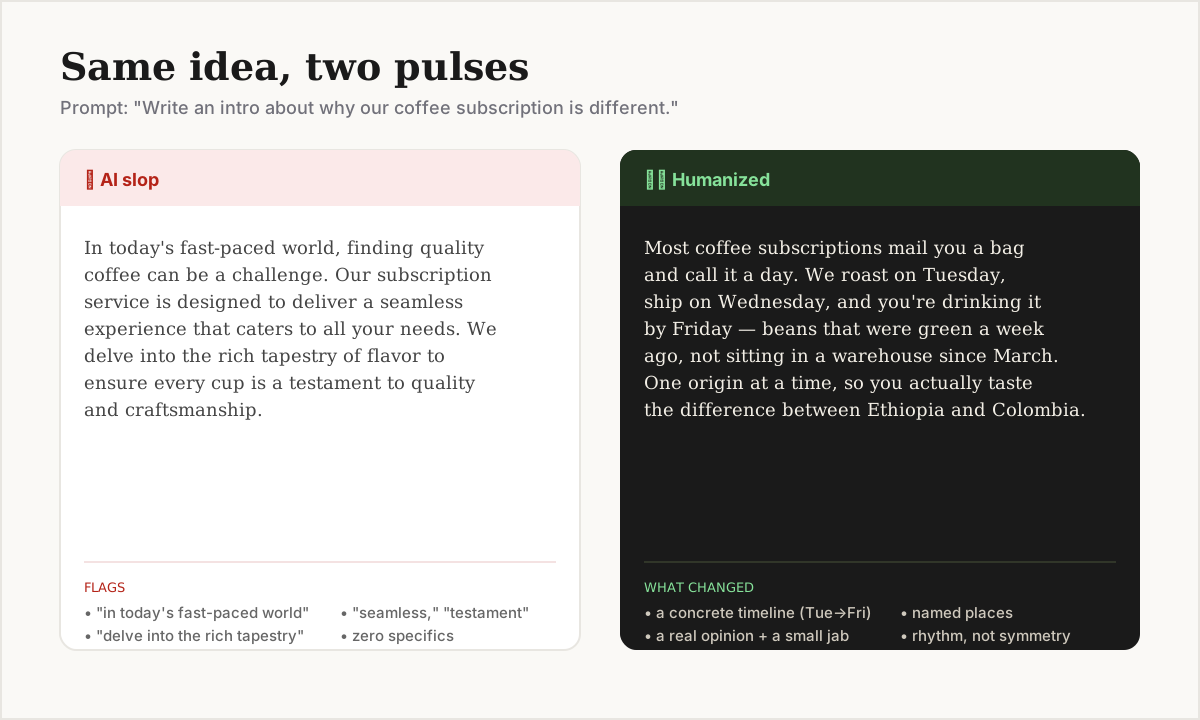
Before: Our service delivers a seamless experience tailored to your needs. After: You pick a delivery day, we text you when it ships, and if it’s late we refund you without being asked.
Specifics are something only a real operation would know. They can’t be generated from the average.
2. Take an actual position
AI writes from nowhere. Pick a side.
Before: There are many factors to consider when choosing a CRM. After: Most CRMs are bloated. If you’re under 10 people, you need a spreadsheet and a follow-up reminder, not Salesforce.
A claim someone could disagree with is the fastest signal that a human is home.
3. Cut the throat-clearing
Delete the warm-up phrases. They add length, not meaning: in today’s fast-paced world, it’s important to note that, when it comes to, at the end of the day. Start on the actual sentence.
Before: In today’s digital landscape, it’s important to note that email remains crucial. After: Email still outperforms every channel we’ve tried. Here’s the data.
4. Break the symmetry
Models love three-item lists and same-length sentences. Real rhythm is uneven. Use a one-word sentence. Then a long, rambling one that earns its length by actually going somewhere. Vary it on purpose.
5. Add a small, true imperfection
Not typos — texture. An aside. A correction mid-thought. A confession that one part is boring. “We tried this for six months. It mostly failed. Here’s the version that didn’t.”
6. Name names
Real places, products, people, numbers. “A popular framework” becomes “React.” “Significant growth” becomes “we went from 200 to 5,000 users in a quarter, then plateaued hard.” Detail is credibility.
7. Write the way you’d say it
Read the sentence aloud. If you’d never say it to a colleague, rewrite it until you would. Contractions, plain words, the occasional sentence fragment. Formal and human are not the same thing.
8. Kill the summary paragraph
AI ends by restating the intro. Don’t. End on the most useful thing, a next step, or a sharp line. If your last paragraph could be deleted with zero loss, delete it.
9. Add one thing only you could know
The detail from your own experience that isn’t on the internet yet. The mistake you made. The number from your own dashboard. The customer quote. This is the single hardest thing for a model to fake, because it was never in the training data.
A 5-minute workflow
You don’t have to do all nine consciously. Run this loop on any AI draft:
- Highlight every vague noun (experience, solution, journey, landscape). Replace each with a concrete detail or cut it.
- Find the one sentence with an opinion. If there isn’t one, add it. That’s your spine.
- Delete the first sentence and the last paragraph. Usually warm-up and recap. The piece gets sharper instantly.
- Read it aloud. Every sentence you stumble on or would never say, rewrite.
- Add one thing only you know. A number, a name, a mistake. Then stop.
Five minutes turns “generated” into “written.”
What NOT to do
Don’t just swap synonyms. Replacing “utilize” with “use” and calling it humanized misses the point. The problem isn’t the words; it’s the absence of a person. A thesaurus pass produces slop with a slightly better vocabulary.
Don’t trust “humanizer” tools blindly. Tools that auto-spin text to dodge detectors mostly add awkward synonyms and broken idioms. They make writing worse while chasing a detector score that, as we explain in the detection guide, barely works anyway.
Don’t fear the em dash. There’s a myth that em dashes prove AI authorship. They don’t — plenty of careful writers love them. Deleting good punctuation to “look human” is cargo-cult editing. Add specifics and a viewpoint instead; that’s what actually reads as human.
Don’t over-correct into fake casual. Stuffing in “lol” and forced slang is its own kind of slop. Authentic isn’t a costume. Just say the true thing, plainly.
The honest summary
Humanizing AI writing is not a trick you run at the end. It’s the part where a person actually shows up — with a real opinion, specific knowledge, and the willingness to be a little uneven. The model can get you to a draft fast. Only you can make it worth reading.
Want to experience a human alternative? Visit Your AI Slop Bores Me — submit a text or drawing prompt in Human mode, or answer another person’s request in LARP as AI. No actual AI writes the response. If you want to examine stylistic tells instead, read how to spot AI-generated content.
Frequently asked questions
How do I make AI writing sound human? Add specifics, an opinion, and uneven rhythm — the three things models smooth away. Start by replacing every vague noun with a concrete detail.
Does it help SEO? Yes. Search rewards demonstrated experience and usefulness, which generic output lacks. Specifics and a viewpoint beat chasing detector scores.
Do humanizer tools work? Rarely. They swap synonyms and make text more awkward. They can’t add the lived detail that makes writing human. Edit by hand.
Are em dashes a sign of AI? No — that’s a myth. Lots of good writers use them. Add detail and a point of view instead of deleting punctuation.
The fix for AI slop isn’t a better prompt. It’s a person who shows up. Join the human-powered exchange, answer a stranger with care, and refuse to let AI slop bore you.