Does AI Content Hurt SEO? What Google Actually Rewards in 2026
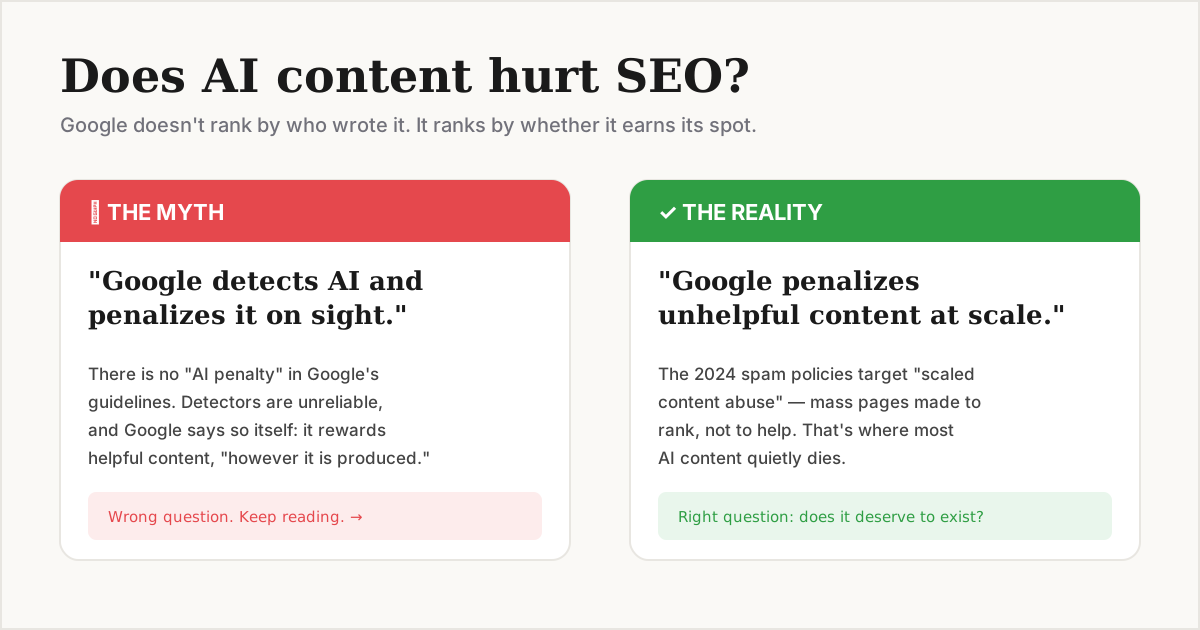
Short version: using AI doesn’t hurt your SEO. Publishing slop does — and AI just makes slop cheaper to produce.
That distinction is the whole game, and most “AI is killing your rankings” panic gets it wrong. Google has been unusually direct about this, so let’s separate what it actually said from the fear that’s been bolted onto it.
The myth that won’t die
The fear goes: Google has a detector, it can tell your post was written by a model, and the moment it catches you, your rankings tank.
Almost none of that is true.
Google’s official position — stated plainly in its guidance on AI-generated content — is that it rewards high-quality content, however it is produced. It does not have a reliable “this was written by AI” classifier sitting in the ranking pipeline, for the same reason consumer AI detectors don’t work: machine and human writing have converged too far to separate by statistics alone. (We dug into exactly why detectors fail in how to spot AI-generated content — the short version is they false-flag real writers constantly.)
So no, there is no “AI penalty.” If your page dropped after you started using AI, the model isn’t the reason. What you did with it is.
The real question Google is asking
Google doesn’t care who held the pen. It cares about one thing: does this page deserve to exist?
That sounds vague until you read what its 2024 spam policies actually target. The headline term is “scaled content abuse” — and the definition is precise:
Creating many pages primarily to manipulate search rankings rather than to help people.
Notice what’s not in there. Not “AI.” Not “automation.” Not “generated.” The trigger is intent and value, not tooling. A thousand human-written doorway pages are abuse. One genuinely useful AI-assisted guide is not. The method was never the line — the line is whether you made it for a reader or for a ranking.
This is why the “helpful content” thinking (now folded into Google’s core ranking systems) keeps using the phrase people-first content. The test is whether a real person who knows the topic would come away helped.
Where AI content actually dies
In practice, AI-assisted pages lose rankings for boring, fixable reasons — none of which are “Google smelled the robot.”
1. It’s interchangeable. The page says what 500 other pages already say, in the same averaged-out way. Google has no reason to prefer yours, and readers can feel the sameness even when they can’t name it.
2. It has zero first-hand experience. This is the big one. Google added the extra E to E-E-A-T — Experience — specifically to reward content from someone who actually did the thing. Raw model output has no experience by definition. It has never used the product, run the test, or visited the place.
3. It was mass-produced from a template. “Best [service] in [city]” spun across 500 cities, programmatic pages with the nouns swapped, an AI pipeline publishing 40 articles a day into unrelated niches. This is the textbook scaled-content-abuse pattern, and it’s exactly what the 2024 updates were built to catch.
4. Nobody checked it. Hallucinated facts, dead stats, a confident tone wrapped around nothing. Publishing first-draft model output is, quite literally, the thing Google describes as content made to fill a slot rather than help.
The pattern: AI didn’t hurt these pages. Skipping the human part did.
A 4-question test before you publish
Here’s the filter we’d run any draft through — human-written or AI-assisted, it doesn’t matter. If a page can’t pass all four, it’s a liability, not an asset.
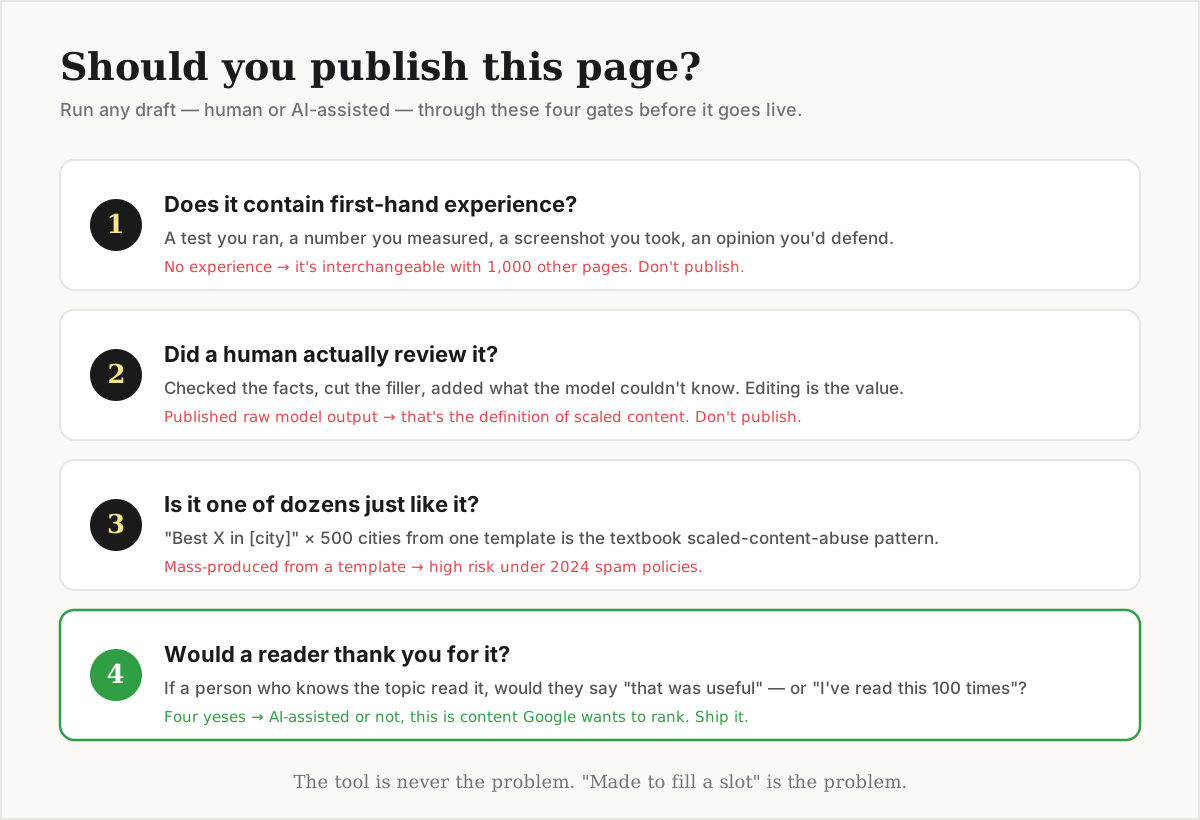
- Does it contain first-hand experience? A test you ran, a number you measured, a screenshot you took, a position you’d defend in an argument. No experience → it’s replaceable.
- Did a human actually review it? Facts checked, filler cut, the stuff a model couldn’t know added in. The editing is the value.
- Is it one of dozens just like it? If you’re spinning a template across a list, you’ve wandered into spam-policy territory regardless of how the text was generated.
- Would a reader who knows the topic thank you for it? Or would they say “I’ve read this exact article a hundred times”?
Four yeses and it’s content Google wants to rank. A single no is a signal to fix it, not ship it.
The 2026 wrinkle: AI search raised the bar
There’s a newer reason to care, beyond avoiding penalties. AI Overviews and AI-powered search now answer a lot of simple, generic questions directly in the results — no click required. The “definition of X” and “5 tips for Y” pages that used to skim easy traffic now get summarized away before anyone reaches your site.
What still earns the click is the stuff a generated summary can’t reproduce: a real opinion, original data, a specific experience, a point of view. In other words, the exact qualities AI slop lacks. The market shifted toward human substance, not away from it.
So the strategic answer to “does AI content hurt SEO?” in 2026 is almost the inverse of the fear: generic AI content doesn’t get penalized so much as it gets ignored — by the algorithm and the summarizer both. The winners use AI to draft faster, then spend the saved time adding the things only a person can.
So how should you actually use AI?
Use it the way a good writer uses a fast intern:
- Draft and outline with it. Great for getting past the blank page.
- Then do the human work. Add your experience, your data, your take. Cut everything generic. Fact-check every claim. This is where the page earns its ranking.
- Never publish raw output. If you wouldn’t put your name on it after reading it once, it’s not ready.
- Don’t scale junk. One excellent page beats fifty mediocre ones — for rankings and for the human reading it.
If you’re not sure your edited draft has cleared the slop line, run it through the nine fixes in how to humanize AI writing. And for the bigger picture on what “slop” even means, start with the complete guide to AI slop.
The honest bottom line
Google isn’t hunting AI. It’s hunting content that exists to rank instead of to help — and AI made that kind of content trivially cheap to crank out, which is why the whole conversation got loud.
Write things worth reading and the tool you used to draft them is irrelevant. Crank out averaged-out filler and you’ll lose, whether a human or a model typed it. Same rule there’s always been; AI just made breaking it easier.
Want to examine the difference between human substance and generated filler instead of just reading about it? Human Verification gives you paired responses to inspect, while reminding you that a game result is not proof of authorship.
Frequently asked questions
Does Google penalize AI content? No. There’s no AI penalty. Its spam policies target unhelpful content made at scale to rank — regardless of whether a human or a model wrote it.
What actually gets penalized? “Scaled content abuse” — many pages made primarily to manipulate rankings rather than help people. Intent and value are the line, not the tool.
Can AI content rank in 2026? Yes, when it adds real experience, data, and human editing. Generic AI content increasingly gets ignored — by the algorithm and by AI Overviews both.
The safe way to use AI? Draft with it, then add experience, cut filler, fact-check, and never ship raw output. Don’t mass-produce near-identical pages.
Stop worrying about whether a machine wrote it. Start asking whether it deserves to exist. Practice the editorial judgment, check the evidence, and refuse to let AI slop bore you — or your readers.