How to Report AI Slop Without Feeding It: An Evidence-First Guide

You found it: a fake expert quote, a product review written by something that has never touched the product, or a twelve-fingered “news photo” spreading faster than the correction.
Your first instinct may be to screenshot it, add “LOOK AT THIS GARBAGE,” and throw it back into the feed.
Congratulations. You may have just given the garbage a second distribution channel.
Calling out AI slop is useful when it helps other people understand what happened. It is less useful when the callout strips away context, sends a mob toward an individual, or spreads the false claim farther than the original post ever traveled.
This guide gives you a better workflow: capture the evidence, verify the problem, report it in the right place, and share only what helps.
First: bad content is not automatically reportable content
Some AI slop is merely boring. Some is deceptive. Some is actively dangerous. Do not treat all three as the same thing.
| What you found | Best first action |
|---|---|
| Generic, repetitive, low-value content | Mute it, block the source, or stop rewarding it with attention |
| Mass-posted spam or engagement bait | Use the platform’s spam-reporting tool |
| Fabricated quote, statistic, or news claim | Preserve the evidence, trace the original source, then report misinformation where appropriate |
| Impersonation, fraud, or a fake commercial offer | Report the account and contact the organization being impersonated |
| Harassment, sexual exploitation, threats, or immediate danger | Use the platform’s safety channel and contact an appropriate local authority when necessary |
| Spectacularly boring public AI output with no immediate safety risk | Nominate it for the AI Slop Hall of Shame |
The distinction matters. “I dislike this” is a review. “This account is impersonating a real person to sell a fake product” is a report. A useful report identifies the rule, risk, or false claim instead of treating “probably made with AI” as the entire case.
If you are unsure whether the material is generated, start with our 15-tell field guide. No single writing quirk, strange hand, or detector percentage proves authorship.
Step 1: capture the original before it changes
Do this before replying, quote-posting, or opening a public argument.
Save:
- The direct URL, not a link to someone else discussing it.
- The account, author, channel, or domain name.
- The visible publication date and the date you accessed it.
- A full-page screenshot or screen recording.
- The exact sentence, image, audio segment, or video timestamp at issue.
- Any label or disclosure shown by the platform.
A cropped screenshot is weak evidence. It may hide the username, date, disclaimer, satire label, or preceding sentence that changes the meaning. Capture the full context first. Make the funny crop later, if it is still useful.
For video or audio, write down the timestamp and transcribe the relevant sentence. “Something weird happens around the middle” is not a report another person can verify.
Use a simple evidence filename:
2026-08-10_platform-account_short-description.png
Boring filenames are good. This is one of the rare places where boring should win.
Step 2: state one checkable problem
“Peak slop” may be emotionally correct, but it gives a moderator nothing to evaluate.
Turn the complaint into one sentence that can be checked:
- Weak: “This whole video is fake.”
- Better: “At 01:14, the video presents a synthetic voice as a direct recording of the named public figure.”
- Weak: “AI wrote this scam article.”
- Better: “The article attributes a quotation to Dr. Rivera, but the linked interview contains no such quotation.”
- Weak: “These product reviews are obviously bots.”
- Better: “Four accounts posted the same 86-word review within six minutes, including the same misspelling.”
Do not begin by proving which model created the material. Begin by proving what is wrong with it.
Authorship is often uncertain. A fabricated citation, copied review, undisclosed impersonation, or false product claim can be investigated directly.
Step 3: trace the claim backward
AI slop loves a citation hall of mirrors. One page cites a newsletter, the newsletter cites a roundup, and the roundup cites “recent research.” Everyone looks sourced. Nobody has opened the research.
Use this four-column claim ledger:
| Claim | Where it appeared | Original source | What the source actually says |
|---|---|---|---|
| “The product cuts energy use by 70%” | Influencer video at 02:08 | Manufacturer press release | Laboratory estimate under one test condition |
| “Experts confirmed the image is real” | Viral post | No named expert or report found | Unsupported |
| “The policy starts Monday” | AI search summary | Government notice | Consultation opens Monday; no policy start date announced |
To trace a claim:
- Search an unusual sentence inside quotation marks.
- Open the oldest or most primary-looking result.
- Follow every citation until you reach the underlying document, recording, dataset, or firsthand statement.
- Compare the original wording with the viral version.
- Note missing limits, dates, sample sizes, or conflicts of interest.
Our AI Search Slop Survival Guide has a fuller operator cheat sheet for finding primary documents.
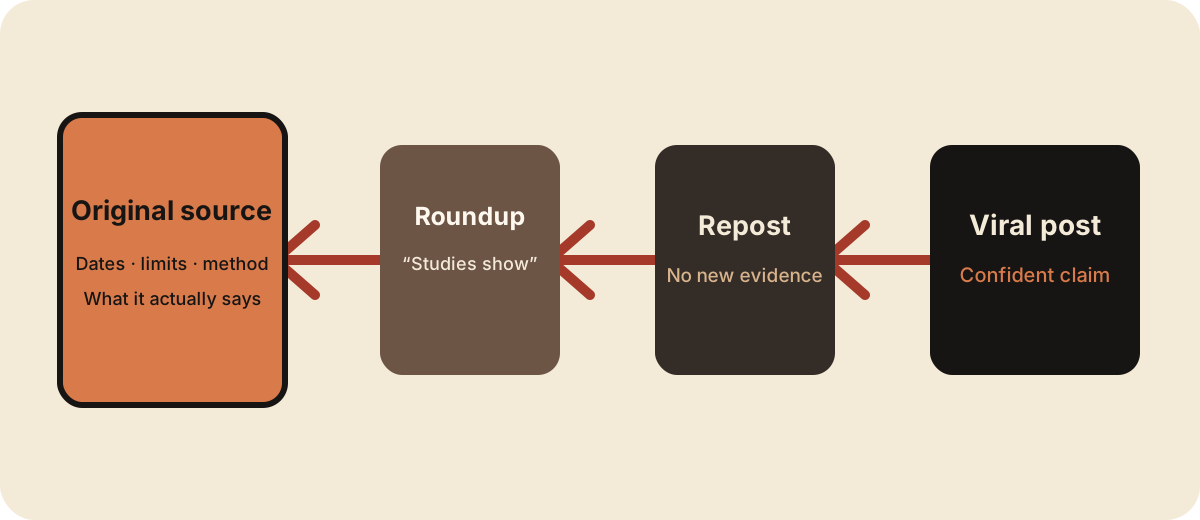
Watch for fake independence
Five articles repeating the same sentence are not five confirmations.
Check whether the pages:
- quote the same unnamed source;
- use identical or near-identical wording;
- link to one press release;
- cite each other in a circle;
- appeared within an implausibly short window.
Count independent reporting paths, not search results.
Step 4: check whether your evidence disproves the claim
Finding no source is not always the same as proving a claim false.
Before writing “debunked,” ask:
- Did I search for the original wording and reasonable variations?
- Could the source be offline, private, paywalled, or in another language?
- Does the evidence contradict the claim, or merely fail to confirm it?
- Am I evaluating the whole item or one specific part?
- Is the content labeled satire, parody, reenactment, or fiction?
Use precise verdicts:
- False: credible evidence directly contradicts the claim.
- Misleading: technically true material is presented without necessary context.
- Unsupported: no traceable evidence was supplied or found.
- Manipulated: genuine media was materially altered.
- Impersonation: content falsely presents itself as coming from another person or organization.
- Low-value slop: mass-produced content that wastes attention but does not make a consequential false claim.
Precision makes the report stronger and reduces the chance that your correction becomes new slop.
Step 5: choose the smallest effective response
Not every bad post deserves a campaign.
Ignore or mute
Use this for harmless, repetitive filler. Attention is the currency that keeps engagement bait alive. If the stream is wearing you down, use the recovery steps in AI Content Fatigue.
Report privately
Use built-in tools for spam, fraud, impersonation, manipulated media, or policy violations. Include the exact URL, timestamp, claim, and category. Moderators do not need a manifesto. They need a reproducible problem.
Notify the affected source
If someone is being impersonated or misquoted, send a short private note containing the link and evidence. Do not demand an immediate public response. Give them what they need to investigate.
Correct publicly
A public correction is useful when the false claim is already circulating and the correction can reach the same audience. Lead with the truth, not the falsehood:
The city has not banned home gardens. The document circulating today is a consultation draft, not an enacted rule. The official notice is here: [link].
Nominate it for the Hall of Shame
For public examples of spectacularly boring, derivative, or absurd AI output, use our Nominate the Worst form.
Bring receipts. The Hall of Shame is for criticism and cultural documentation, not doxxing private people or escalating personal disputes.
Step 6: write a report someone can act on
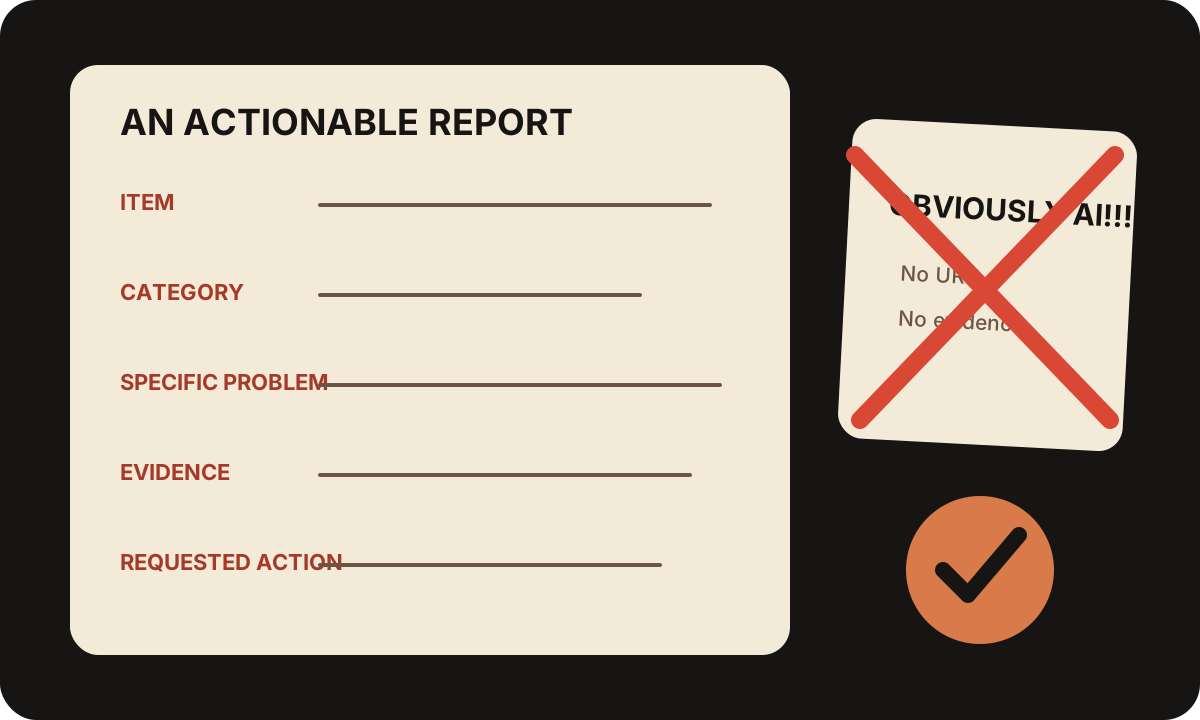
Use this five-part template:
Item: [Direct URL and account/domain]
Category: [Spam / impersonation / false claim / manipulated media / other]
Specific problem: [One checkable sentence]
Evidence: [Screenshot, timestamp, original source, or comparison]
Requested action: [Review, label, remove, correct, or investigate]
Example:
Item:
example.com/post/123, published August 9
Category: Fabricated quotation
Specific problem: The article attributes “We expect a 70% reduction this year” to the agency director.
Evidence: The linked August 7 briefing contains no such statement; the only 70% figure refers to a 2035 planning scenario on page 18.
Requested action: Correct the quotation and add a visible correction note.
That report is calm, specific, and difficult to dismiss. It also avoids claiming more than the evidence shows.
The two-minute Hall of Shame submission
The Hall of Shame asks for a title, category, description, and optional example URL. A strong nomination can be written in four sentences:
- What is it? Identify the public tool, post, campaign, or output.
- What makes it slop? Name the observable failure.
- Why does it matter? Explain the wasted attention, deception, repetition, or harm.
- Where is the evidence? Link the original public example when safe.
Example:
A network of finance pages published the same “independent” product review under different bylines. Each article repeats the same unsupported performance number and links to the seller’s press release rather than a test. The pages create the appearance of independent consensus where none exists. Original example: [URL].
One is evidence. “This sucks. Obviously AI. Everyone go yell at them” is a mob invitation wearing a media-literacy hat.
Do not turn the report into more slop
Before posting publicly, run this final check:
- Context: Did I preserve the date, source, and surrounding material?
- Necessity: Does sharing the content help people verify the problem?
- Privacy: Did I remove private addresses, phone numbers, faces, or unrelated usernames?
- Proportionality: Am I criticizing a public output or directing abuse at a person?
- Accuracy: Did I separate “false,” “misleading,” “unsupported,” and “probably AI”?
- Amplification: Can I describe the problem without re-uploading the entire deceptive item?
- Correction path: If I am wrong, is there a clear way to update or remove my claim?
The goal is not to win a dunk contest. The goal is to leave the information environment slightly cleaner than you found it.
A pocket checklist
When time is short, remember C-L-E-A-R:
- C — Capture the original URL, date, account, and full context.
- L — Locate the exact checkable claim or failure.
- E — Examine the primary source and independent evidence.
- A — Act through the smallest effective channel.
- R — Reduce unnecessary amplification, exposure, and personal targeting.
You do not need forensic software. You need five careful minutes and the refusal to let confident formatting substitute for evidence.
AI slop thrives on speed: generate, publish, react, repeat. The useful response is slower by design. Capture first. Check the source. Name the actual problem. Then decide whether the right button is report, correct, mute, or Nominate the Worst.
The internet already has enough confident noise. Bring receipts.