The Boring Internet: Why Everyone's Desperate for Digital Authenticity in 2026
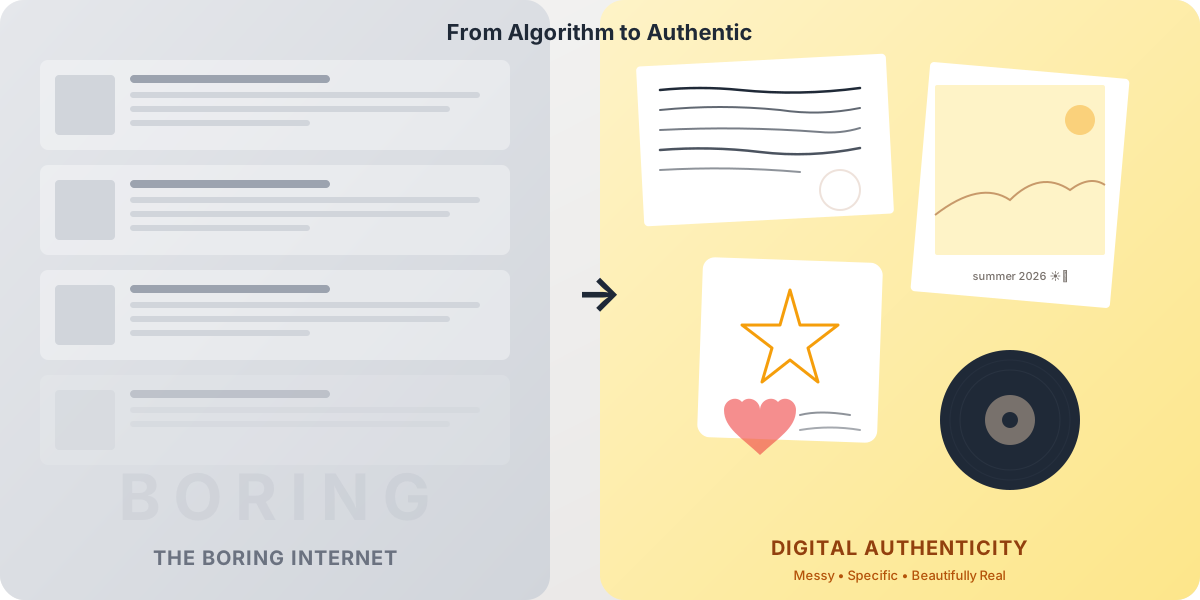
When was the last time you found something genuinely weird on the internet?
Not weird in a “this was clearly generated by an AI that doesn’t understand context” way. Actually weird. Made-by-a-human-with-a-vision weird. The kind of thing that makes you think “who spent time making this, and why, and how do I become their friend?”
If you can’t remember, you’re not alone. The internet in 2026 feels… dead. Or at least deeply boring. And there’s a growing movement of people who’ve had enough.
The Dead Internet Isn’t a Theory Anymore
“Dead Internet Theory” used to be a fringe conspiracy — the idea that most online content and interactions were generated by bots, not real people. In 2026, it doesn’t feel like a conspiracy anymore. It feels like a description.
Scroll through any social media feed. How much of what you see was made by a person who genuinely wanted to share something? And how much is algorithmically placed content designed to extract engagement from you?
The answer is increasingly uncomfortable. Between AI-generated posts, bot accounts, SEO-optimized filler, and engagement-bait, the amount of genuinely human content you encounter in a typical browsing session is shrinking every day.
This is what we mean when we talk about AI slop. It’s not just bad content. It’s content that displaces real human expression. Every AI-generated article that ranks on Google is a human article that doesn’t. Every AI-generated video that fills a feed is a human creator who doesn’t get seen.
The Analog Rebellion
Something interesting is happening in response: people are going offline.
Dumbphones are becoming status symbols. Physical books are outselling e-readers for the first time in years. Board game cafés are packed. People are journaling on paper, cooking from printed recipes, and choosing vinyl records over streaming.
This isn’t nostalgia. It’s a deliberate rejection of what the digital world has become. When every online experience feels optimized, curated, and vaguely artificial, the imperfect reality of physical things becomes deeply appealing.
There’s a reason our Circle of Truth game resonates so much — it asks you to draw a circle by hand. That’s it. No AI assistance, no auto-correction, no optimization. Just your hand, your imperfection, and a score that celebrates how beautifully human your wobbly circle is.
The appeal isn’t the circle. The appeal is doing something that a machine can’t do better. Or rather, doing something where being “better” isn’t the point.
Why the Internet Got Boring
The internet got boring because optimization won. Every piece of content is now optimized for engagement, for SEO, for conversion. The result is that everything looks the same, reads the same, and feels the same.
Remember when websites had personality? When someone’s personal blog had a weird background color and Comic Sans and strong opinions about obscure topics? That internet is gone. Replaced by clean templates, predictable layouts, and content that says nothing controversial because controversy doesn’t optimize well.
AI accelerated this problem by orders of magnitude. When anyone can generate “content” on any topic in seconds, the floor drops out. There’s no incentive to be different when being the same is so much cheaper and faster.
The irony is crushing: the internet was supposed to be the great equalizer, giving everyone a voice. Instead, it became a machine that amplifies the most generic voice possible and drowns out everything else.
The Authenticity Craving
Here’s what’s changed in 2026: people have stopped accepting it.
There’s a growing cultural movement that values authenticity over perfection. Not performative authenticity (the Instagram kind where you carefully stage a “candid” moment). Real authenticity. The kind where you can tell the difference between human and AI content not because one is better, but because one actually comes from a person who lived through something.
This is why platforms like YouTube are cracking down on AI slop. This is why “slop” became Merriam-Webster’s word of the year. This is why a simple game called “Your AI Slop Bores Me” went viral — because the name captures exactly what everyone is feeling.
We’re bored. We’re bored of perfectly formatted LinkedIn posts that say nothing. We’re bored of AI-generated images of sunsets that no one actually saw. We’re bored of articles that answer questions nobody asked in a tone that belongs to nobody.
What Digital Authenticity Actually Looks Like
Digital authenticity in 2026 isn’t about going completely offline (though that’s tempting). It’s about being intentionally human in digital spaces:
It’s messy. Real human content has rough edges. Typos that reveal a person was typing fast because they were excited. Tangents that go nowhere but reveal how someone actually thinks. Opinions that are wrong but interesting.
It’s specific. AI content is generic by nature — it’s trained on everything, so it represents nothing in particular. Human content is specific. It references that one café on the corner of 5th and Main. It mentions a conversation with a friend last Tuesday. It smells like a real life.
It’s risky. Humans are willing to be wrong, controversial, or unpopular. AI is trained to hedge, to present “balanced” views, to avoid offending anyone. The result is content with all the personality of a corporate press release.
It’s weird. The best human content is the stuff that makes you go “huh, I never thought about it that way.” AI never produces that reaction because it can only recombine existing thoughts. It can’t have a new one.
Fighting Back
The boring internet isn’t inevitable. It’s a choice — and increasingly, people are choosing differently.
Some are creating. Making weird art. Writing long blog posts about topics they care about. Recording podcasts where they actually say what they think instead of what the algorithm wants to hear.
Some are curating. Finding the human content that still exists and sharing it. Building communities around real conversation instead of engagement metrics.
And some are playing games that celebrate humanity. Our Human Verification game literally asks you to prove you’re not a bot through a series of absurd challenges. Our Slop Runner lets you outrun the algorithm. Our Hall of Shame lets you call out the worst AI slop on the internet.
These aren’t just games. They’re acts of resistance against a boring internet.
The Internet We Deserve
The internet can be weird again. It can be surprising, challenging, offensive, beautiful, ugly, and deeply human. But only if we actively fight for it.
Every time you create something real, you push back against the slop. Every time you support a human creator, you vote for the internet you want. Every time you refuse to engage with AI-generated filler, you starve the machine that produces it.
The boring internet didn’t happen to us. We let it happen. And we can un-let it.
Start by being more human today. Say something only you would say. Make something only you would make. Share something that comes from your actual experience, not from a prompt.
Need inspiration? Come play our games — they’re specifically designed to celebrate everything a machine can’t do. Or read through the AI Slop Hall of Shame and remind yourself why authentic content matters.
The internet isn’t dead yet. It’s just waiting for us to bring it back to life.